Two cell types, used in sequence. Natural killer (NK) cells clear what the body needs removed. Mesenchymal stem cells (MSC) then support repair of what remains. One platform, two jobs.
Dual-Shield describes how NiSCELL organises its platform. The two therapies are manufactured and studied separately. NiSCELL does not claim that combining them has been shown to work better than either one alone.
Two cell types, used in sequence
01
Clear
NK cells
Natural killer cells are part of the body's own immune system. They recognise and remove cells that are damaged, aged or abnormal, without needing to be told what to look for first.
Understood to act on
Clearing senescent cells, meaning cells that have stopped dividing but have not been removed
Clearing pathogens
Acting on cancer-forming cells
Supporting general immune function
02
Repair
MSC
Mesenchymal stem cells are adult stem cells. They support the repair and regeneration of damaged tissue, and they signal to the tissue around them rather than simply replacing it.
Understood to act on
Supporting repair of damaged cells and tissue
Signalling to surrounding tissue
Low immunogenicity, meaning the recipient's body is less likely to react against them
Holding both, and manufacturing both to the same standard, is what makes NiSCELL a platform rather than a set of separate therapies. The two are made and studied separately. The word platform describes how the company is organised, not a combined product.
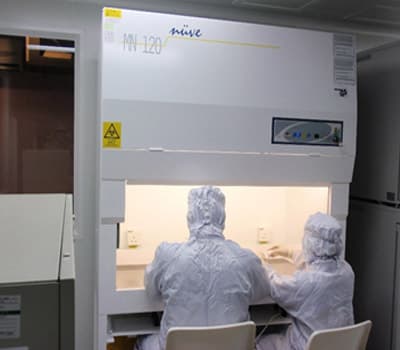
Both cell types are handled open in a biosafety cabinet, in the same Grade B suites, to the same procedure.
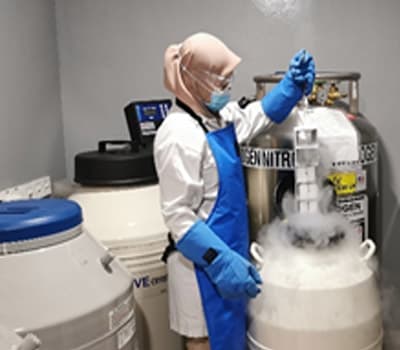
Cryopreservation. Both are stored in vapour-phase liquid nitrogen. NiSCELL facility, Petaling Jaya.
What NiSCELL makes now
Three · each with a status box
Every product below is published with the same five fields: what it is for, where it has got to, who it is for, what it is not, and what evidence exists. The fourth field is not a disclaimer. It is the first thing a serious reader checks, so it is printed at the same size as everything else.
AIET
Autologous Immune Enhancement Therapy
A person's own immune cells, taken out, increased in number in the cleanroom, and returned.
AIET stands for Autologous Immune Enhancement Therapy. Autologous means the cells come from the same person who receives them. Natural killer (NK) cells, and in some cases T cells, are collected from a patient's blood, expanded and activated under cGMP conditions, and returned by a clinician. The platform came from the Biotherapy Institute of Japan in 2009 and has been run at NiSCELL for fifteen years.
Tracks
Wellness and immune enhancement
NK cells
Aimed at supporting the immune functions a healthy body already performs.
Clinician-directed immune support
NK cells and T cells
Prepared at a treating clinician's direction, alongside the care that clinician is already providing, to support immune function.
A supportive measure. Not a treatment for any condition, and not considered a cure.
Status
AIET
Purpose
To collect, expand and activate a person's own immune cells under cGMP conditions, for administration by a clinician.
Current status
In manufacture. Produced at the NiSCELL facility, which is cGMP accredited by the NPRA.
Intended audience
Clinicians and their patients. Research partners.
What it is not
Not a cure for cancer. The immune support track is a supportive measure used alongside the care a clinician is already providing, at that clinician's direction.
Not available direct to the public, and not sold without a clinician.
Not a substitute for any treatment a doctor has prescribed.
Evidence available
Manufacturing and release records. Facility accreditation. The platform's transfer history from the Biotherapy Institute of Japan, 2009.
Stem cells from donated umbilical cord tissue, screened to international tissue banking standards.
MSC stands for mesenchymal stem cell, a type of adult stem cell that supports tissue repair. NiSCELL's MSCs are UC-MSC, meaning they are derived from umbilical cord tissue donated after birth. They are allogeneic, meaning one screened donor's cells can be prepared for a different person, so the product does not have to be made from scratch for each recipient. Cord tissue is abundant, the cells grow readily, and their low immunogenicity means the recipient's body is less likely to react against them.
Collection standard
American Association of Tissue Banks (AATB), Standards for Tissue Banking, 15th edition.
Donor criteria
Healthy donors under 27, first pregnancy.
Screening
Blood testing, communicable and infectious disease screening, family history, and screening for chromosomal abnormalities.
Type
Allogeneic. Donor derived, prepared for a recipient who is not the donor.
Status
UC-MSC therapy
Purpose
To manufacture allogeneic UC-MSC to a documented collection and screening standard, for administration by a clinician and for research use.
Current status
In manufacture. Collected to AATB 15th edition standards. Allogeneic MSC research has run at NiSCELL since 2013.
Intended audience
Clinicians, research partners, and sponsors sourcing MSC manufacture.
What it is not
Not a registered medicine, and not approved for any named indication.
Not available direct to the public.
Not offered for longevity or general renewal, and not offered for any developmental condition.
Not a treatment for osteoarthritis, wound healing, autoimmune conditions or diabetes. Those are areas of ongoing research at NiSCELL, not conditions it treats.
Evidence available
AATB 15th edition collection standards. Donor screening records. Facility accreditation. University research collaborations with USM, UiTM and UPM.
NK Activity Test
Natural killer cell activity test
A laboratory measure of how active a person's natural killer cells are.
Natural killer (NK) cells are immune cells that remove damaged or abnormal cells. The NK Activity Test measures how active a person's NK cells are in the laboratory. It is an immune monitoring tool. It gives a clinician a baseline before treatment and a way to see how that measure moves afterwards.
Baseline assessment
Establishes a person's NK activity level before treatment begins.
Response monitoring
Allows a clinician to compare NK activity over the course of treatment.
Follow-up
Supports a clinician in setting an individual follow-up strategy.
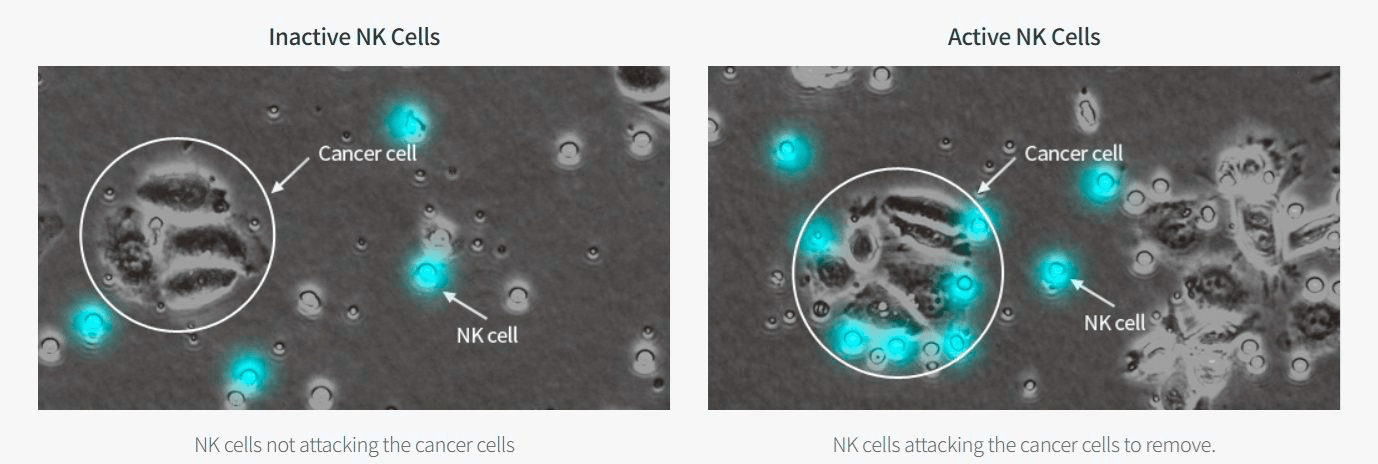
Figure 1 · NiSCELL micrographs. Inactive NK cells, left, beside active NK cells attaching to cancer cells, right. The test measures NK activity in the laboratory. It does not diagnose anything.
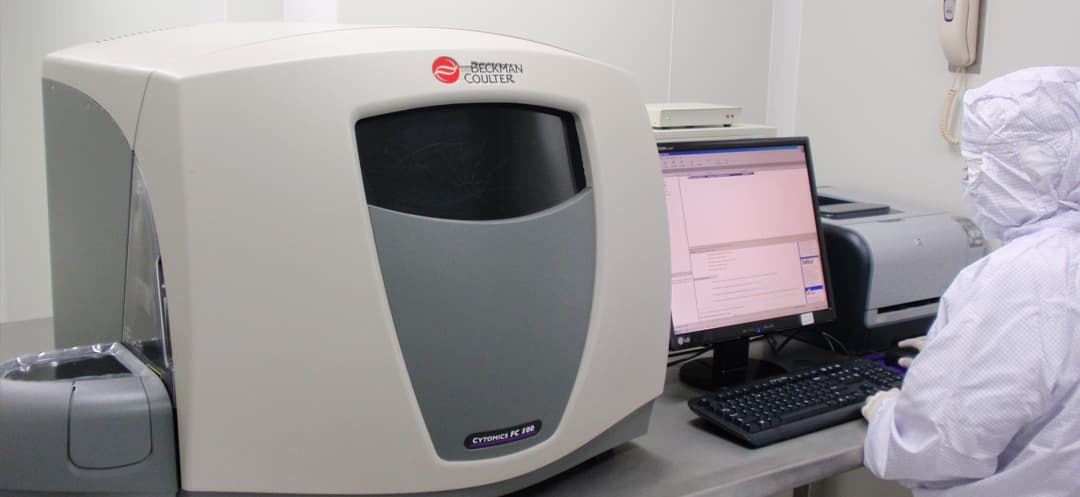
Figure 2 · A Beckman Coulter Cytomics FC 500 in use at NiSCELL. Cell analysis work is done on the floor rather than sent out.
Status
NK Activity Test
Purpose
To measure natural killer cell activity, so a clinician has a baseline and can evaluate response to treatment.
Current status
In use as an immune monitoring tool. NK cell activity testing has been performed at NiSCELL since 2021.
Intended audience
Clinicians and research partners.
What it is not
Not a diagnostic test kit for any disease.
Not a screening test for cancer, and not a test that tells anyone whether they have a disease.
Not a substitute for diagnostic testing ordered by a doctor.
Evidence available
Assay method and laboratory records. NK activity micrographs, published on the evidence page.
Cell therapies are prescribed and administered by clinicians. If you are a patient or caregiver, please speak to your doctor.
The research behind the platform
Two programmes sit behind the products at research stage, secretome and exosomes, and neither is a product. The record of collaborations, grant numbers and accreditations is set out separately.